
Connectivity for the places a truck cannot reach.
Submarine fiber
Subsea cable landing stations, power feed equipment and seabed surveying — with the terrestrial backhaul and resilience design that make a submarine link dependable.
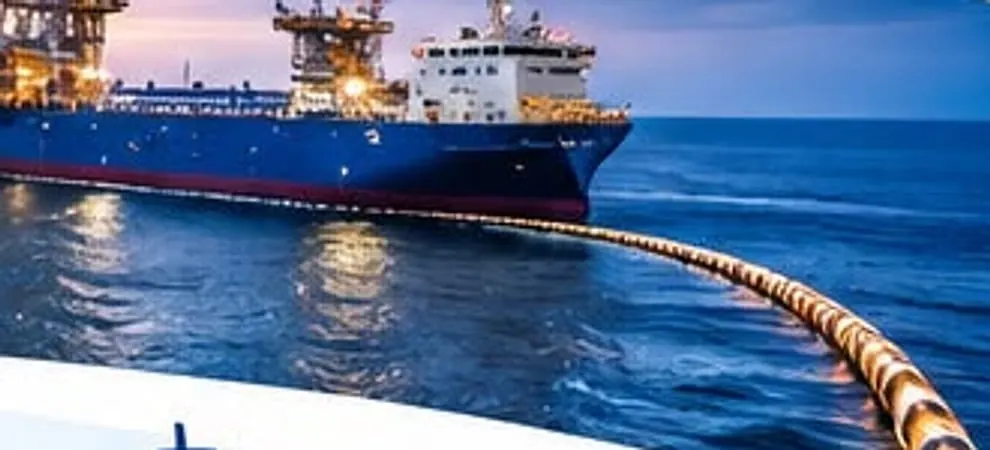
An offshore facility on a satellite link is a facility that runs its operations at the mercy of weather and latency. Submarine fiber changes what is possible: real-time control data, remote expert support, condition monitoring and crew welfare on a link that behaves like a terrestrial one.
We work on the parts of that chain an operator actually has to own — the seabed survey, the landing station and its power feed equipment, the terrestrial backhaul, the platform termination and the redundancy design — alongside the marine contractors who lay the cable.
Designed around a single point of failure that cannot be dug up
A subsea break is a vessel mobilisation, not a van. Topology, diverse landings, protection paths and satellite fallback are decided against that reality and the operator's real tolerance for downtime.
Subsea cable landing systems
Power feed equipment (PFE) and terrestrial backhaul interconnectivity, specified for salt, humidity and power quality, with the earthing and surge coordination a shore landing actually needs.
Platform termination done once
Hazardous-area classification, structural routing, J-tube entry and terminal equipment coordinated with the platform's own engineering rather than treated as an IT delivery.
What rides on it, designed with it
Control data, voice, radio over IP, CCTV and crew connectivity prioritised on a link whose capacity and latency are known — rather than contending for it after the fact.
Capabilities
Scope of work
Planning and design
- Requirements
- Capacity, latency and availability targets set against the actual operation
- Seabed surveying
- Seabed and route survey to plan the cable path, burial and protection
- Route support
- Desktop study, permitting input and liaison with marine installation contractors
- Topology
- Point-to-point, festoon and branched designs with diverse landing assessment
- Resilience
- Protection paths, satellite or microwave fallback and defined failover behaviour
Landing and terminal
- Landing station
- Beach manhole, landing chamber, terminal building fit-out
- Power feed equipment
- PFE installation, earthing and commissioning at the landing station
- Terminal equipment
- Line terminal, DWDM and monitoring
- Power and earthing
- DC plant, standby supply, earthing and coordinated surge protection
- Backhaul
- Terrestrial onward connectivity and interconnect to the operator's core
Offshore termination
- Platform entry
- J-tube routing, hang-off and cable protection coordinated with platform engineering
- Hazardous area
- Equipment and installation per IEC 60079 for the classified areas involved
- Termination
- Splice enclosures, patching and terminal equipment in the platform equipment room
- Environment
- Marine-grade materials, ingress protection and vibration-tolerant mounting
Services carried
- Control and telemetry
- SCADA and condition monitoring with latency and determinism understood
- Voice and radio
- IP telephony and radio-over-IP extended to shore
- Safety systems
- PA/GA and mass notification linked across platform and shore
- Video and welfare
- CCTV, remote expert support and crew connectivity, prioritised below operations
Figures on these pages describe what we routinely deliver. Anything specific to your site is confirmed from a survey before it is priced.
Standards we work to
ITU-T G.97x series
Optical fibre submarine cable systems
ICPC recommendations
International Cable Protection Committee practice
ITU-T G.652 / G.654
Single-mode fibre characteristics for long-haul and submarine use
IEC 60079 series
Explosive atmospheres — equipment and installation
IEC 61892
Mobile and fixed offshore units — electrical installations
IEC 62305
Protection against lightning
IEC 61280
Fibre optic communication subsystem test procedures
Typical applications
- Fixed platform and FPSO connectivity to shore
- Marine and oil terminal communications
- Offshore wind and energy island links
- Island and remote coastal facility connectivity
- Diverse-path resilience for existing satellite-dependent sites
- Landing station build and terminal equipment upgrade
What you receive
- Seabed route survey report
- Requirements and availability study with stated assumptions
- Topology and resilience design, including failover behaviour
- Landing station and platform termination design packages
- Optical budget and end-to-end performance calculation
- Interface schedule with marine installation contractors
- Commissioning and acceptance test records
- Operations documentation and fault escalation procedure
Where we do it
Oil & gas
Hazardous-area communications and DC power for plants, terminals and offshore.
Power & utilities
Protection, control, SCADA communications and DC power for grids and substations.
Government authorities
Mission-critical radio, secure networks and standby power for public agencies.
Frequently asked questions
Before you send an enquiry
Do you lay the cable yourselves?
No, and anyone who tells you they do all of it should be asked which vessel. Cable-lay is specialist marine contractor work with its own vessels and permits. We survey the seabed route and deliver the parts the operator owns — landing station, power feed equipment, backhaul, platform termination, resilience and the services carried — and we coordinate the interfaces with the lay contractor so nothing falls between the two scopes.
Is submarine fiber realistic for a single platform?
Sometimes, and sometimes honestly not. It depends on distance to shore, what the connectivity is worth operationally, and whether the route can be shared with other facilities or an existing system. We will do the study and tell you when the answer is that a microwave link or a better satellite arrangement serves you for a fraction of the cost.
What happens when the cable breaks?
A repair is a vessel mobilisation measured in weeks, not hours — which is why the design matters more than the response plan. We design assuming a break will happen: diverse landings where the economics allow, a defined fallback path, and agreement in advance about which services keep running on reduced capacity.
Next step
Let’s build a connected tomorrow.
Contact our engineering team to design, upgrade or manage your critical telecom infrastructure. Send a scope, a drawing or just the problem, and we will come back with an approach and a priced proposal.